SHORT SHIRTS THAT WON'T STAY TUCKED — SOLVED
Your shirt tail is too short to grip. Every solution you've tried fails within an hour. Here's why it happens and the one fix that actually works for short tails.
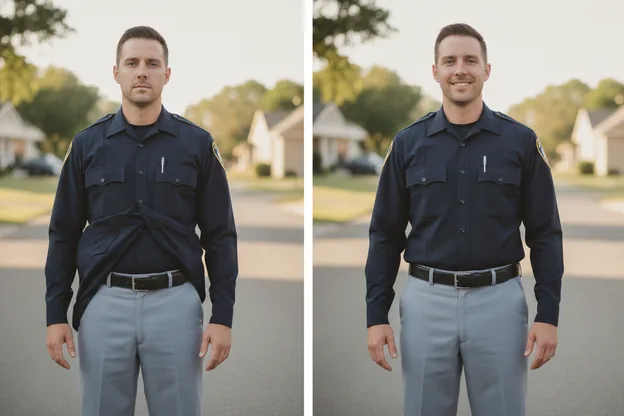 BeforeAfter

Duty, desk and weekend — the same belt in every one.
Short shirt tails come untucked because there isn't enough fabric below the waistband to create friction. The fix: a rubber shirt stay belt like the Shirt Tucker ($19.99) that grips the fabric itself at the waistline — not from below. Unlike leg straps or the military tuck, it works even with shirts that have only 2–3 inches of tail below the waistband.
WHY SHORT SHIRTS COME UNTUCKED
Understanding the physics of why short shirts come untucked is the first step to fixing it. Every time you tuck a shirt in, you're relying on two forces to keep it there: friction between the fabric and your pants, and gravity pulling the fabric downward. When a shirt has a long tail, gravity wins — there's so much fabric below the waistband that it creates its own anchor point. The weight of the tail holds the shirt in place.
With a short shirt tail, you have the opposite problem. There's minimal fabric below the waistband — sometimes only 2–4 inches. This means:
- Less friction surface area: Less fabric touching your pants means less grip. The waistband is doing almost all the work, and waistbands aren't designed to grip fabric — they're designed to grip your waist.
- No gravitational anchor: A short tail doesn't weigh enough to pull itself down and stay put. It essentially floats at the waistband level, and any upward movement pulls it out.
- Movement amplifies the problem: Every time you reach up, bend over, sit down, or twist your torso, your body creates an upward pull on the shirt. With a long tail, this pull is absorbed by the excess fabric. With a short tail, it goes directly to the tuck point and the shirt pops out.
- Body shape matters: If you have a longer torso relative to the shirt's length, the tail is even shorter once tucked. Athletic builds with broader shoulders and tapered waists create more movement distance, which means more opportunities for a short tail to escape.
The core physics: A tucked shirt is held in place by friction at the waistband. Short tails have less friction surface area and no gravitational anchor, so they come untucked with normal movement. The solution must add grip at the waistband — not below it.
COMMON SOLUTIONS FOR SHORT SHIRTS — RANKED
There are five common approaches people try for keeping a short shirt tucked. Some work better than others, and one works dramatically better than the rest. Here's an honest ranking.
1. The Military Tuck
The military tuck involves folding excess fabric at the sides of your shirt to create a tighter, cleaner fit. You pinch the fabric at each side seam, fold it back, and tuck the folded fabric into your waistband.
Does it work for short shirts? Poorly. The military tuck relies on having excess fabric to fold — which is the exact thing short shirts don't have. If your tail is only 3 inches below the waistband, there's nothing to fold. Attempting a military tuck on a short shirt often makes things worse by reducing the amount of fabric actually inside the waistband.
Verdict: Good for long shirts, ineffective for short shirts.
2. Buying Longer Shirts
The most straightforward solution — just buy shirts with longer tails. Brands like Untuckit popularized the "designed for untucking" shirt, but several brands now make "extra long" versions of standard dress shirts with 3–4 additional inches of tail.
Does it work? Yes, if you're willing to replace your entire wardrobe. The problem is cost and practicality. Most people have short shirts they already own and like — they just want them to stay tucked. Replacing 10–20 shirts at $40–80 each is a $400–$1,600 problem. And for uniform wearers, you often can't choose your shirt length.
Verdict: Works but expensive and impractical for existing wardrobes and uniforms.
3. Leg-Strap Shirt Stays
Traditional shirt stays clip to the bottom of your shirt and connect to your socks or a leg strap, creating downward tension that holds the shirt in place.
Does it work for short shirts? Counterintuitively, leg stays can make the short-shirt problem worse. They pull the shirt fabric downward, which is fine when there's plenty of fabric to work with. But on a short shirt, that downward pull creates tension at the waistband that can actually cause the fabric to ride up unevenly or pop out at the front when you sit. The clips also have a minimum fabric length requirement — if the tail is too short, the clips can't attach properly.
Beyond effectiveness, leg stays are uncomfortable. The elastic creates constant tension between your shirt and your legs, restricting movement and causing chafing on longer wear. They also don't work with shorts.
Verdict: Can worsen the problem on short shirts. Uncomfortable and restrictive.
4. Shirt-Grip Tape or Silicone Strips
Some products apply adhesive or silicone directly to the inside of your waistband to create a grippy surface. The idea is that the shirt fabric sticks to the silicone and doesn't slide up.
Does it work for short shirts? Partially. Silicone strips do add friction at the waistband, which helps. But they have limitations: they lose grip as they get warm and sweaty, they can irritate skin, they leave residue on fabric, and they need to be replaced frequently. For a short shirt with minimal tail, you need a strong, consistent grip — not a sometimes-sticky strip.
Verdict: Marginal improvement. Not reliable for active movement or all-day wear.
5. Rubber Shirt Stay Belt (The Shirt Tucker)
The Shirt Tucker is a rubber belt that wraps around your waist over the tucked shirt, then sits beneath your regular belt. The rubber grips the shirt fabric with continuous, 360-degree friction. It doesn't depend on tail length because it grips the fabric at the waistline itself — not from below.
Does it work for short shirts? Yes — and this is where the Shirt Tucker excels specifically. Because the rubber grips fabric at the waist (not below it), even a shirt with only 2–3 inches of tail stays locked in place. The rubber creates a hold point at exactly the location where short shirts fail. Your body movement — bending, reaching, sitting — doesn't pull the shirt past the rubber grip because the grip is at the failure point.
Verdict: The best solution for short shirts. Works regardless of tail length.
| Solution | Works for Short Shirts? | Cost | Comfort |
|---|---|---|---|
| Military Tuck | No — requires excess fabric | Free | Good |
| Longer Shirts | Yes | $400–$1,600+ | Good |
| Leg-Strap Stays | Can worsen problem | $12–$20 | Poor |
| Silicone Strips | Partial | $8–$15 | Fair |
| Shirt Tucker Rubber Belt | Yes — best option | $19.99 one-time | Good |
HOW THE SHIRT TUCKER FIXES SHORT TAILS
The key insight is where the Shirt Tucker grips. Every other solution either tries to add friction below the waistband (where short shirts don't have enough fabric) or tries to pull fabric downward (which doesn't work when there's nothing to pull). The Shirt Tucker grips fabric at the waistband — the exact point where short shirts fail.
Tuck your shirt in normally
Even if the tail is only 2–3 inches, tuck it in as best you can. Don't worry about it being perfect.
Wrap the Shirt Tucker around your waist
Place the rubber belt over the tucked shirt, at the waistband level. Find the right hole for your size — snug but comfortable.
Insert the flex peg
Press the rubber button into your size hole. One motion, one hand, under 10 seconds.
Put on your regular belt over it
Your regular belt goes on top, compressing the rubber against the shirt fabric. The rubber now grips the shirt with continuous 360-degree friction.
The result: your shirt is held in place by a rubber grip that doesn't depend on tail length, doesn't restrict movement, and doesn't lose grip over the course of a day. It's the difference between relying on gravity (which fails with short tails) and relying on friction (which works regardless of tail length).
Why it works for short tails specifically: The rubber grips the fabric at the waistband — the exact point where short shirts escape. Even 2–3 inches of tail is enough because the grip point is at the tuck, not below it. Every other solution tries to hold fabric from below, which requires length you don't have.
TIPS FOR KEEPING SHORT SHIRTS TUCKED
Beyond using a Shirt Tucker, these tips help maximize your tuck with shorter shirt tails:
- Tuck into underwear first: Tuck the shirt into your underwear before putting on pants. This adds a friction layer and a second waistband to grip the fabric. Combined with a Shirt Tucker, this creates a near-unbreakable hold.
- Choose the right pants: Higher-rise pants and pants with tighter waistbands hold tucks better. Low-rise pants sit below your natural waist, which effectively shortens your shirt tail even further.
- Fabric matters: Smooth, silky fabrics slide more easily. Cotton, linen, and textured fabrics create more natural friction. If your short shirt is also silky, a rubber belt becomes even more important.
- Maintain your belt tension: A loose belt allows your waistband to shift, which loosens the tuck. Keep your belt snug — the Shirt Tucker works best when compressed by a firm belt.
- Mind your movements: Reaching overhead and twisting are the two movements that untuck short shirts fastest. If you know you'll be reaching, keep your arms slightly lower to reduce the pull on your shirt.
WHICH SHIRTS ARE MOST LIKELY TOO SHORT?
Certain shirt styles and situations create the short-tail problem more often than others:
- "Modern fit" dress shirts: Many contemporary brands cut shirt tails shorter for a more casual look. Great for wearing untucked, terrible for tucking.
- Polos: Most polos have shorter tails than dress shirts. The casual design assumes you might wear it untucked, so they trim the tail.
- Uniform shirts: If your employer provides uniform shirts, they're often cut to a standard length that may not match your torso length. Tall individuals are especially affected.
- Shirts that have shrunk: After repeated washing, cotton shirts lose 1–3 inches in length. A shirt that tucked fine when new may be too short after a year of laundering.
- Longer torsos: If your torso is proportionally long, even "regular length" shirts may have short tails relative to your body. This is especially common in athletic builds.
FINALLY FIX SHORT SHIRT TAILS
The rubber belt that grips even the shortest shirt tails. Works with any shirt, any pants, any belt.
Buy Now — $19.99