THE HISTORY OF SHIRT STAYS FROM MILITARY TO MODERN
Shirt stays have been keeping uniforms sharp for nearly 200 years. Here's how they evolved from military invention to the everyday accessory millions rely on.
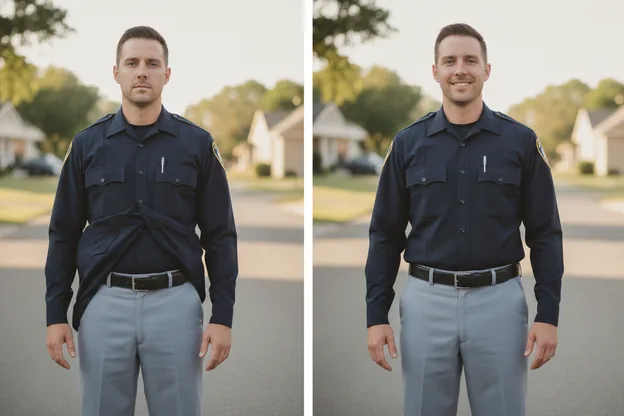 BeforeAfter

Duty, desk and weekend — the same belt in every one.
Shirt stays originated in 19th-century military uniforms. Early designs used metal clasps and garters to maintain sharp creases during parades and inspections. They evolved from restrictive leg-strap designs through elastic innovations to modern rubber belts like the Shirt Tucker — which eliminated leg straps entirely and introduced waist-only grip through friction technology.
THE 1800S: MILITARY NECESSITY EMERGES
The story of shirt stays begins with military precision. In the 1800s, armies across Europe and North America required uniform standards for dress parades, inspections, and formal ceremonies. A tucked shirt was non-negotiable — but maintaining that tuck through hours of standing, marching, and movement was nearly impossible with ordinary clothing.
Early military innovations paired metal clasps (called "suspenders" or "braces") with cloth garters. These simple devices clipped to the shirt hem and ran down the inside of the leg, attaching to a band around the calf or sock. The concept was straightforward: downward tension kept the shirt from riding up.
The problem was comfort. These garter designs restricted leg movement, created pressure points at the thigh, and required constant adjustment. Soldiers complained constantly. But they worked well enough that militaries stuck with them — a shirt stay was a shirt stay, and perfect creases mattered more than comfort.
THE 1900S–1950S: THE GARTER AGE DOMINATES
For the first half of the 20th century, garter-style shirt stays became the worldwide standard. The British military refined the design with higher-quality elastic. The U.S. military adopted leg straps across all branches — Navy, Army, Marines. Police departments, formal event staff, and even flight attendants standardized garter-based stays.
Designs improved incrementally: better elastic, reinforced clips, adjustable length. But the core weakness remained — elastic has a fatal flaw. Elastic memory fails. After months of daily use, the elastic loses elasticity. It stretches out permanently, stops gripping, and eventually tears. A soldier or officer would go through several sets of garter stays per year.
By the 1950s, the garter stay was ubiquitous but frustrating. People had normalized the discomfort: restricted leg movement, visible clips and straps under dress shirts, constant readjustment during the day. There had to be a better way — but innovation hadn't arrived yet.
THE 1960S–1970S: ELASTIC BELTS EMERGE AS AN ALTERNATIVE
In the 1960s and 1970s, manufacturers began experimenting with elastic belts — a middle ground between garter stays and traditional belts. These wrapped around the waist like a belt but were made entirely of elastic material, designed to grip the shirt through tension rather than leg attachment.
The advantage was obvious: no leg straps, more freedom of movement. The disadvantage was equally clear: elastic degrades. Within a few months of regular use, elastic belts stretched out and lost their grip. Users had to replace them frequently or accept a loose, ineffective stay.
Additionally, elastic belts created bulk under dress shirts. The thick band was visible under tailored clothing, and the grip was inconsistent — it worked better with some shirt materials and poorly with others.
Elastic belt technology became a niche option but never displaced garter stays as the military and formal-wear standard. The invention was promising but the material science wasn't ready.
THE 1980S–2000S: RUBBER TECHNOLOGY ENTERS THE MARKET
In the late 1970s and early 1980s, as rubber manufacturing advanced, innovative designers began experimenting with rubber as a shirt-stay material. Unlike elastic, rubber maintains its grip indefinitely. Rubber doesn't fatigue, doesn't lose memory, and doesn't degrade under normal daily use.
Rubber-belt shirt stays appeared sporadically throughout the 1980s and 1990s, mostly sold through military supply catalogs and specialty retailers. Early rubber designs were crude — the rubber was too thick, the construction was basic, and sizing was limited. But they worked. A rubber belt would last for years, not months.
The rubber revolution happened quietly. Military branches began quietly switching to rubber-based stays. Police departments issued rubber belts as standard. Nurses and healthcare workers discovered rubber stays held up through long shifts and frequent movement. But rubber stays remained largely unknown to the general public — they were a professional tool, not a consumer product.
Throughout the 1990s and 2000s, rubber-belt technology slowly improved. Manufacturers refined the rubber compound, added padding, created better sizing systems. By the early 2000s, rubber belts were the superior option — they just weren't marketed as consumer products. You had to know where to look to find them.
THE 2010S: GROWTH AND AWARENESS ACCELERATES
As e-commerce expanded, rubber shirt stays became more accessible. Small retailers began selling rubber belts online. Word of mouth spread through professional communities — military forums, law enforcement groups, nurse groups.
But the market remained fragmented. Rubber stays were sold through dozens of small brands, with inconsistent sizing, variable quality, and limited visibility. Most consumers still didn't know rubber was an option — they either bought cheap elastic belts at department stores or turned to garter stays.
The real shift happened as men's fashion evolved. Casual dress became more common in workplaces. Untucked shirts started feeling normal. But for professionals who still needed sharp creases — nurses, military personnel, police, salespeople, event staff — the need for shirt stays remained constant.
During this period, online reviews and YouTube started spreading awareness. Men discovered that rubber stays worked better than garter stays. Athletic communities (baseball, golf, tennis, basketball referees) found that rubber stays allowed freedom of movement that garter stays couldn't match.
THE 2020S: MODERN RUBBER INNOVATION BECOMES MAINSTREAM
In 2023, the Shirt Tucker launched as the first modern, consumer-focused rubber shirt-stay belt. Rather than continuing with utilitarian designs, the Shirt Tucker reimagined what a rubber stay could be: precise sizing, refined rubber compound, beautiful design, and transparent communication about how it works.
The Shirt Tucker modernized the entire category by:
- Eliminating leg straps — Waist-only grip through friction, not tension
- Precision engineering — Optimal rubber thickness for all body types
- Consumer marketing — First rubber stay brand to reach mass-market awareness
- Full transparency — Detailed guides explaining the physics of how modern rubber stays work
- Quality assurance — Rigorous testing and 30-day returns to build trust
- Cultural shift — Positioning shirt stays as everyday accessory, not just uniform tool
The Shirt Tucker brought 200 years of shirt-stay history to its logical conclusion: a product that actually works, that doesn't require leg attachment, that holds its grip for years, and that looks clean under any shirt. It's the evolution the category needed.
EVOLUTION TIMELINE AT A GLANCE
| Era | Design Type | Key Characteristics | Lifespan |
|---|---|---|---|
| 1800s | Metal Clasps + Cloth Garters | Leg straps, manual adjustment, visible under shirt | 1–2 years |
| 1900s–1950s | Elastic Garters | Leg straps with improved elastic, standard military issue | 3–6 months |
| 1960s–1970s | Elastic Belts | Waist-only, no leg straps, but elastic degrades quickly | 4–8 months |
| 1980s–2000s | Rubber Belts (Professional) | Durable, long-lasting, but limited availability and marketing | 3–5 years |
| 2020s | Modern Rubber (Shirt Tucker) | Engineered grip, consumer-focused, transparent design, full freedom of movement | 5+ years |
WHY THE HISTORY MATTERS FOR YOUR CHOICE TODAY
Understanding the evolution of shirt stays explains why rubber is the only sensible choice today. Every other design was an invention born from necessity and material limitations that no longer exist.
Garter stays made sense in 1900 because elastic hadn't been invented yet and downward tension was the only known grip mechanism. Elastic belts made sense in 1970 because rubber manufacturing wasn't mature. But in 2026, both designs are relics.
The Shirt Tucker represents the culmination of 200 years of iteration. It solves every problem that haunted earlier designs:
Modern Rubber
- Maintains grip indefinitely (no elastic fatigue)
- No leg straps (full freedom of movement)
- Works through friction physics (no tension pulling at hips)
- Lasts 5+ years on average
- Invisible under dress shirts
- Adjusts one size fits all for all body types
Older Designs
- Elastic loses grip within months
- Garters restrict leg movement
- Downward tension causes discomfort
- Requires frequent replacement
- Visible clips and straps
- Limited sizing options
THE MODERN SHIRT STAY
The Shirt Tucker — 200 years of history, finally engineered right. $19.99.
Shop Now — $19.99