RUBBER BELT SHIRT STAY HOW IT WORKS AND WHY IT'S BETTER
The physics of rubber grip vs elastic tension — why one method outlasts and outperforms the other for most shirt-tucking situations.
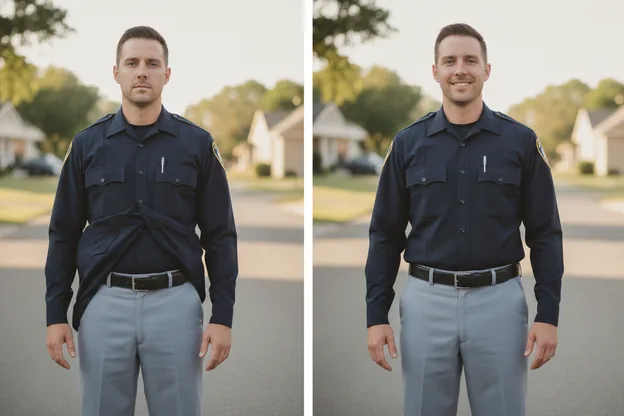 BeforeAfter

Duty, desk and weekend — the same belt in every one.
A rubber belt shirt stay works through lateral friction — the non-slip rubber surface grips the shirt fabric from all sides simultaneously, preventing upward migration. This is fundamentally different from elastic leg stays, which work through downward tension. Rubber outperforms elastic for sports because friction holds through rotation; elastic-tension fails because rotation breaks the line of pull. Rubber also outlasts elastic because rubber has no "memory fatigue" — it returns to its original shape after every stretch.
THE SCIENCE BEHIND RUBBER BELT SHIRT STAYS
Every shirt stay on the market uses one of three forces to keep your shirt in place: downward tension, mechanical clamping, or friction grip. Understanding how each force works explains why some methods fail in practice even when they sound good in theory — and why a simple strip of rubber outperforms products with far more complex engineering.
Three Forces, Three Approaches
Downward tension (leg straps): Elastic straps connect the shirt tail to the sock or thigh and pull the shirt downward. The holding force comes from the elastic's stored energy. The problem is directional — the tension only works straight down. Any lateral movement (twisting, bending sideways, rotating during a golf swing) breaks the line of pull. The shirt can still migrate upward between the attachment points. Elastic also suffers from memory fatigue: after hundreds of stretch cycles, the material permanently elongates and loses tension. Most elastic straps lose noticeable grip within 3 to 6 months.
Mechanical clamping (clips, magnets): A rigid connection pinches the shirt and pants together at specific points. The holding force comes from spring tension or magnetic attraction. The problem is coverage — a clip only holds the exact point where it is attached. The shirt fabric between clips remains free to billow and migrate. Clips also concentrate all the force on a tiny area of fabric, which can wear through delicate materials over time.
Friction grip (rubber belts): A rubber surface presses against the shirt fabric and holds it through static friction. The holding force comes from the contact between two surfaces. This force is omnidirectional — it resists movement in every direction simultaneously. There is no line of pull to break. The entire circumference of the shirt is gripped at once, leaving no free fabric to migrate upward.
Why Rubber Is the Superior Material
Rubber has a naturally high coefficient of friction against woven fabrics like cotton and polyester blends. This means it grips without needing to squeeze tightly. A rubber belt does not need to be uncomfortably tight to work — moderate contact pressure is enough for the friction to exceed the upward force of a shirt trying to untuck.
Rubber also does not suffer from memory fatigue the way elastic does. When you stretch rubber and release it, it returns to its original shape and retains the same friction properties. A rubber belt worn daily for two years grips the same as the day you bought it. Elastic, by contrast, progressively loosens and never recovers.
How the Shirt Tucker Uses This Principle
The Shirt Tucker is a rubber belt that wraps around your waist over the tucked shirt, under the pants. It connects with a simple flex peg closure — no buckle, no metal clasp, no moving parts to break. The entire inner surface is rubber, creating friction grip across the full circumference. Setup takes about 10 seconds. It fits waists from 22 to 48 inches and comes in Black, White, and Grey at $19.99 with free U.S. shipping and 30-day returns. Typical lifespan is 2 to 4 years.
What Customers Say About Performance
"I'm an engineer so I appreciate the simplicity. No clips, no elastic, no moving parts. Just friction doing its job all day." — Mechanical engineer, office setting
"Replaced my leg straps after 3 months when the elastic gave out. This rubber belt is going on year two and grips exactly the same." — Security officer
"Full 18 holes, hot day, lots of twisting. Shirt stayed tucked the entire round. The rubber just works." — Golfer, 34" waist
Related Guides
THE DETAILS
The physics of rubber grip vs elastic tension — why one method outlasts and outperforms the other for most shirt-tucking situations.
A rubber belt shirt stay works through lateral friction — the non-slip rubber surface grips the shirt fabric from all sides simultaneously, preventing upward migration. This is fundamentally different from elastic leg stays, which work through downward tension. Rubber outperforms elastic for sports because friction holds through rotation; elastic-tension fails because rotation breaks the line of pull. Rubber also outlasts elastic because rubber has no "memory fatigue" — it returns to its original shape after every stretch.
THE SHIRT TUCKER
The rubber belt that keeps shirts tucked all day. No leg straps.
Shop Now — $19.99