DO SHIRT STAYS CAUSE BAD POSTURE?
Constant downward pull has to act against something. Here's how leg-strap tension can travel up your body — and the design that removes it.
 BeforeAfter
Workdays, weekends and the course — the same belt in every one.
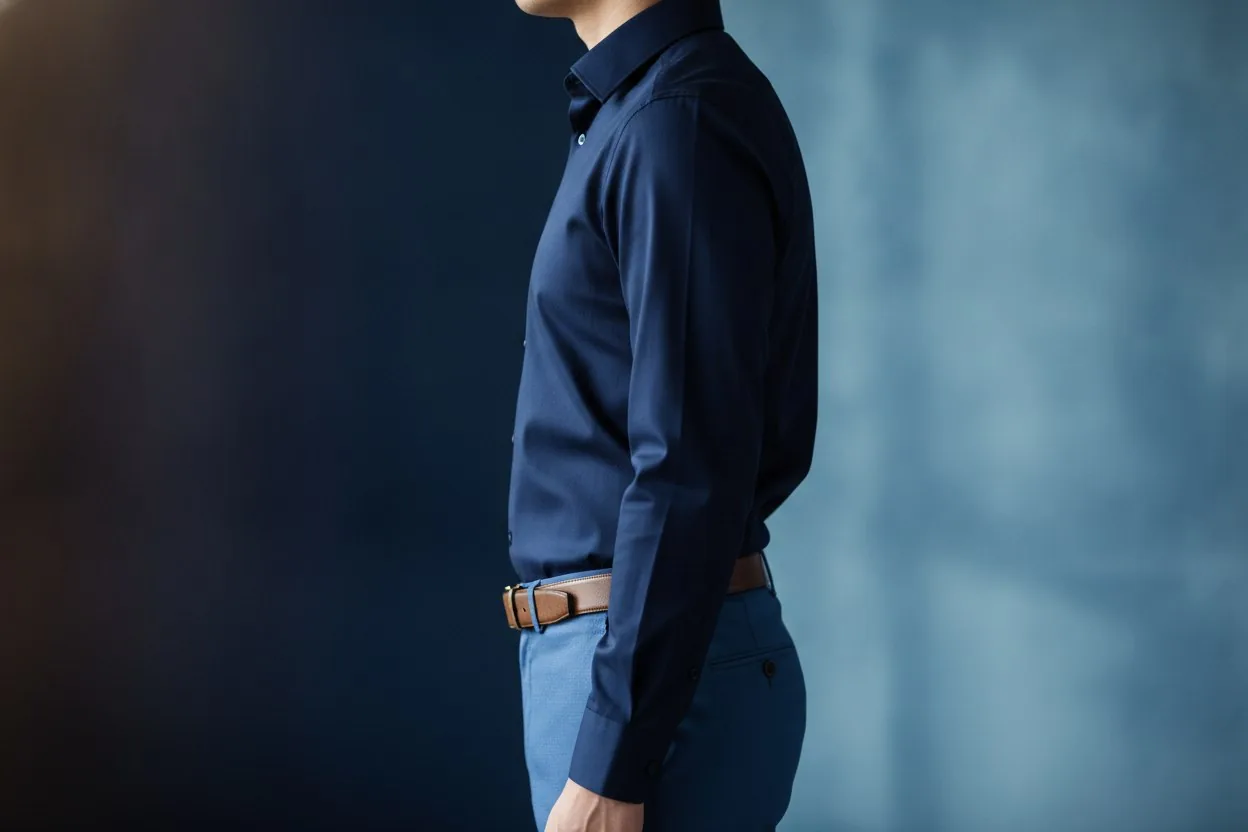
Constant downward tension has to pull against something — sometimes that's your shoulders.
It can, in a small way. Leg-strap stays work by pulling your shirt down toward your socks under constant tension, and some wearers report that steady downward pull encourages the shoulders to round forward slightly over a long day. It's rarely dramatic, but it's real. A waist-only rubber belt applies no downward tension at all — it grips the shirt by friction at the waist — so there's nothing pulling on your torso and nothing to affect how you stand.
HOW TENSION TRAVELS UP YOUR BODY
Start with a basic principle of forces: tension always has to resolve somewhere. When a leg-strap stay pulls your shirt down toward your socks, that downward force doesn't just vanish. Your shirt is a connected garment wrapped around your torso, so a small share of the pull travels up through the fabric to the shoulders and collar, where the shirt is anchored across your upper body.
Individually, that share is tiny — a gentle, persistent downward tug on the front of your shirt. But "gentle and persistent" is exactly the kind of input the body quietly adapts to. Held for an eight-hour day, a light forward-and-down pull on the shirt front can nudge some people to let their shoulders roll slightly forward, the beginning of a rounded, slouched posture.
It's important to keep this honest and in proportion. This is a subtle, comfort-level effect that some wearers notice and many don't. It is not a diagnosed medical condition, and a shirt stay won't reshape your spine. But if you've ever finished a day in garters feeling a little hunched or tight across the shoulders, the mechanism above is a plausible reason why.
WHO NOTICES IT MOST
Not everyone feels this equally. The people most likely to notice are those who wear their stays tightest and longest. Cranking the adjuster up to keep a stubborn shirt down increases the downward tension, which increases whatever share travels to the shoulders. Wear that for a twelve-hour shift and the effect has all day to accumulate.
Desk workers can be sensitive too, because sitting already encourages a forward slump, and a constant downward shirt pull layers onto that tendency rather than fighting it. People who are already mindful of their posture — anyone rehabbing shoulder or neck tension, for instance — often report being the first to feel a subtle new pull and to want it gone.
On the other end, plenty of wearers feel nothing at all, especially at lower tension. The point isn't that leg straps wreck everyone's posture. It's that a constant pull is a variable you'd rather not add if you don't have to — and you don't.
FRICTION VS TENSION: THE KEY DIFFERENCE
Here's the distinction that changes everything: there are two completely different ways to keep a shirt tucked, and only one of them puts force on your body. Leg straps use tension — they hold the shirt by continuously pulling it downward. A rubber waist belt uses friction — it holds the shirt by pressing it flat against your waist so it can't ride up.
Friction is a lateral, self-contained grip. The belt squeezes gently at the waistband and the shirt simply stays put; there's no ongoing pull directed anywhere. Nothing is trying to drag your shirt front toward the floor, so nothing is nudging your shoulders. Your torso is left completely free to stand however it naturally does.
That's why the friction approach sidesteps the posture question entirely rather than just softening it. It's not a gentler tension — it's the absence of tension. Remove the pull and you remove anything for your posture to react to.
STAND TALL WITHOUT THE PULL
The Shirt Tucker is that friction-based design. It's a rubber belt you wear around your waist, over your tucked shirt and under your trousers. It grips the shirt at the waistband and holds it down through the day without a single strap running to your legs and without any downward tension on your torso.
Practically, that means you put it on in about 30 seconds, forget it's there, and finish the day standing exactly the way you started — no accumulated forward pull, no tight shoulders from a stay you couldn't feel but your body was quietly bracing against. For anyone who wants a crisp tuck without inviting even a subtle slouch, removing the tension is the cleanest way to do it. You keep the sharp look and drop the pull.
Friction (Rubber Belt)
- No downward tension on your torso
- Nothing pulling your shoulders forward
- Holds the shirt by lateral grip at the waist
- Leaves your body free to stand naturally
- On in 30 seconds, forgettable all day
Tension (Leg Straps)
- Constant downward pull on the shirt front
- Some of that force travels to the shoulders
- Can nudge shoulders to round over a long day
- Worst when worn tight or for long shifts
- Adds a pull you'd rather not carry
NO DOWNWARD PULL, NO SLOUCH
The Shirt Tucker holds your shirt by friction — no tension pulling on your posture. $19.99.
Shop Now — $19.99